 blog
blog
Quartz vs Granite Countertops for Kitchens: 2026 Guide
Table of Contents
- Quartz vs Granite: Quick Comparison Table
- What Sets Quartz and Granite Apart
- Durability, Hardness, and Stain Resistance
- Quartz Countertop Heat Resistance and Thermal Shock
- Granite Countertop Maintenance Requirements and Sealing
- Cost of Kitchen Countertop Installation: Quartz vs Granite
- UV Stability, Repairability, and Resale Value
- Conclusion
- Frequently Asked Questions
Last Updated: September 11, 2026
Quartz vs Granite: Quick Comparison Table
The decision between quartz and granite countertops for kitchens often comes down to a trade-off: granite offers a one-of-a-kind natural slab, while quartz (engineered stone) provides predictable color, a nonporous surface, and minimal sealing requirements. At RestMark Renovations, we guide homeowners through this choice on nearly every kitchen renovation project. The best answer usually depends on your cooking habits, tolerance for upkeep, and how long you plan to stay in your home.
Here is a brief overview before diving into the details:
| Factor | Quartz (Engineered Stone) | Granite (Natural Slab) |
|---|---|---|
| Material | Ground quartz + resin binder | Quarried natural stone |
| Look | Consistent color, uniform veining | Unique veining, slab uniqueness |
| Porosity | Nonporous | Porous, requires sealing |
| Heat resistance | Moderate, resin can scorch | High, tolerates hot pans |
| Maintenance | Wipe-and-go | Periodic sealing and resealing |
| Repairability | Professional chip repair only | Can be re-polished after chip repair |
| UV stability | Can fade or yellow in direct sun | Effectively fade-resistant |
| Best for | Busy kitchens, low-maintenance households | Cooks who want a natural, heat-proof surface |
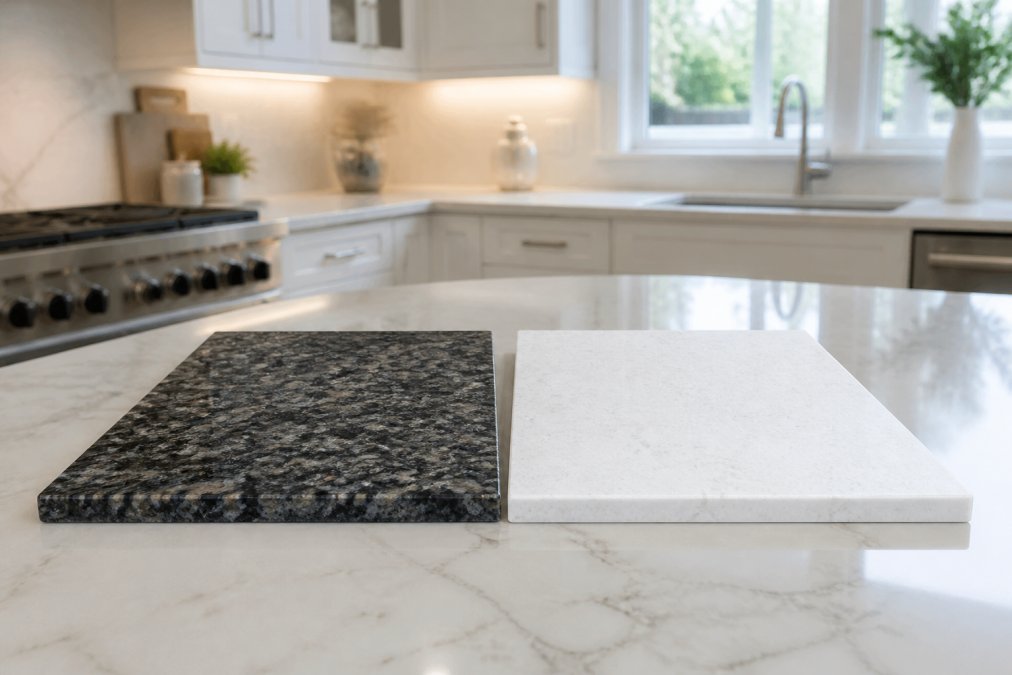
Below, we will break down durability, heat resistance, maintenance, the cost of kitchen countertop installation, and long-term considerations often overlooked: UV fading, repairability, resale value, and sustainable sourcing.
What Sets Quartz and Granite Apart
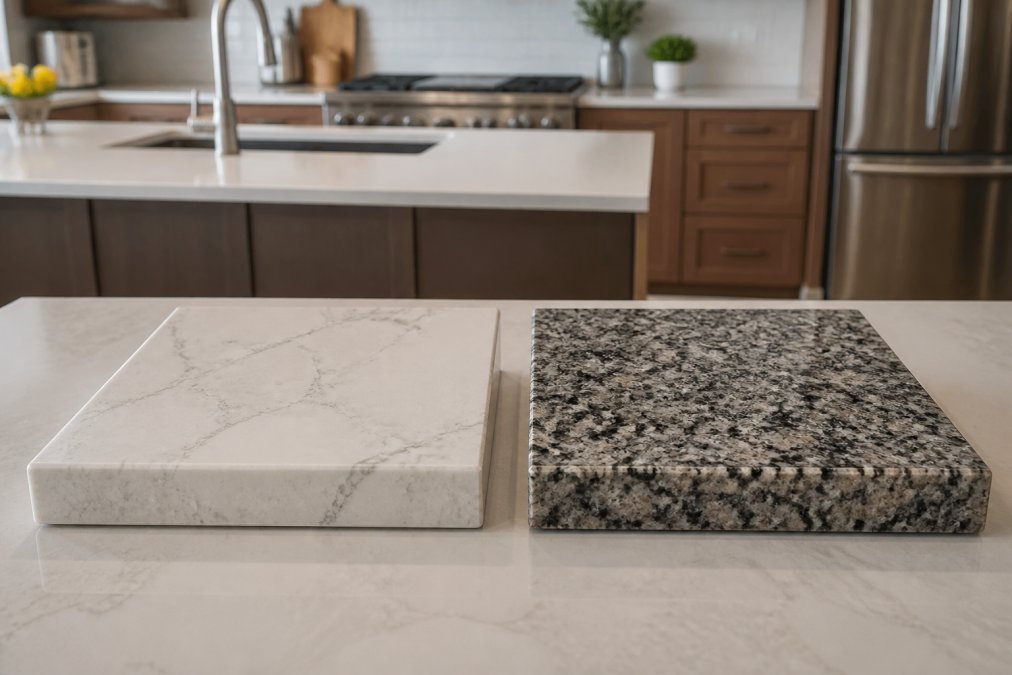
The fundamental difference lies in their origin. Granite is a natural slab quarried from the earth, whereas quartz is an engineered stone manufactured from ground quartz mixed with a resin binder. This single distinction influences almost every other difference between them.
Granite: Natural Slab, Unique Veining
Granite forms deep underground and is cut into slabs, meaning no two pieces are identical. The veining, mineral content, and color consistency vary from slab to slab, and even across a single slab. For a kitchen that feels grounded in natural stone, this uniqueness is a primary appeal. The caveat is that you select a specific slab, and what you see is precisely what you get, including any natural imperfections.
Quartz: Engineered Stone, Consistent Color
Quartz is a synthetic, resin-based material, allowing manufacturers to control the pattern, color, and surface finish. You can specify a honed or polished finish and be assured that every slab in a production run will match. If you have seen granite installations where one slab appears darker than the next, you understand the importance of uniformity in a large kitchen renovation.
Durability, Hardness, and Stain Resistance
Both quartz and granite are hard, durable surfaces, but they can fail in different ways. On the Mohs hardness scale, quartz ranks around 7, and granite is slightly higher. However, real-world scratch resistance depends as much on the finish as the mineral content (geology.com).
The more significant practical difference is porosity. Quartz is nonporous, meaning spills remain on the surface and wipe away easily, preventing bacterial growth. Granite is porous, which is why its stain resistance relies on proper sealing. A well-sealed granite slab can resist most kitchen spills, but an unsealed or improperly sealed surface will absorb oils, wine, and acidic liquids.
Quartz Countertop Heat Resistance and Thermal Shock
Quartz countertop heat resistance is the material's most apparent weakness. The resin binder can soften under sustained heat, so placing a hot pan directly on the surface can cause scorching, discoloration, or a permanent mark. Thermal shock, a rapid temperature change, can also crack the resin matrix, particularly at an edge.
Granite handles heat much better. As solid natural stone without a resin component, it tolerates hot cookware with significantly less risk. While not indestructible, it is the safer choice for those who frequently move pans directly from the oven to the counter.
Granite Countertop Maintenance Requirements and Sealing
Granite countertop maintenance requirements are manageable but not negligible. Plan on resealing the surface periodically, typically every one to two years depending on usage, and promptly wiping up oil and acidic spills rather than letting them sit (marble-institute.com).
Daily care is straightforward: use warm water, mild soap, and a soft cloth. Avoid abrasive cleaners and acidic products that can dull the finish over time. Quartz, in contrast, requires no sealing, making it the preferred choice for many busy households.
- Granite: reseal periodically, clean with mild soap, avoid acids.
- Quartz: no sealing required, clean with mild soap, avoid abrasive pads.
- Both: use trivets and cutting boards to protect the surface finish.
Cost of Kitchen Countertop Installation: Quartz vs Granite
The cost of kitchen countertop installation varies based on slab selection, edge profiles, cutouts, and the overall layout size, making a single figure misleading. Generally, quartz and granite fall within a similar price range once fabrication and installation are factored in, and the gap often narrows based on project specifics.
Factors that influence the price:
- Slab choice. Exotic granite and premium quartz options can push prices to the higher end. A standard granite slab and a mid-tier quartz slab often have comparable prices per square foot, while rare granite or designer quartz can cost significantly more.
- Edge profiles. A simple eased edge is less expensive than a decorative profile. Bullnose, ogee, and waterfall edges require more fabrication time and can add hundreds of dollars to the project.
- Cutouts. Undermount sinks and cooktops necessitate additional fabrication work. Each cutout is a separate operation, and a farmhouse sink apron adds complexity.
- Layout. More seams and corners increase labor. An L-shaped kitchen with a peninsula has more seams than a straight run, and each seam requires careful fabrication.
- Removal and disposal. If replacing an existing countertop, removal and disposal add to the total cost. Some fabricators include this service, while others bill it separately.
The material cost is only one component of the total. Fabrication, templating, delivery, and installation often constitute a substantial portion of the final invoice, so comparing only the slab price per square foot can be deceptive. Request a detailed quote that itemizes material, fabrication, and installation to ensure an accurate comparison.
Because pricing is dependent on your specific slab, layout, and finish selections, RestMark Renovations prices each kitchen individually. You can review current price ranges and request a quote on the RestMark Renovations pricing page.
UV Stability, Repairability, and Resale Value
Three factors distinguish a countertop that ages gracefully from one that dates your kitchen: its reaction to sunlight, its repairability, and how potential buyers perceive it at resale. These aspects are often overlooked but are crucial for long-term satisfaction.
UV Stability: Why Sunlight Matters More Than You Think
Granite is highly resistant to fading, so a sun-drenched kitchen's appearance will not change over time. Quartz, however, can be susceptible to UV degradation; prolonged direct sunlight may cause yellowing or fading (PubMed). This is a significant consideration for kitchens with large south-facing windows or skylights. If your kitchen receives hours of direct sun, opting for a darker quartz or a granite slab is a safer choice. Lighter-colored quartz tends to show yellowing more prominently than darker tones. If you desire quartz in a sunny kitchen, choose a mid-to-dark color and consider using window treatments during peak sun hours.
Repairability: What Happens When You Chip It
Natural stone has an advantage here. A chip in granite can often be filled and re-polished by a fabricator, making it largely disappear. A chip in quartz typically requires a professional resin repair, and matching the pattern can be challenging. While scratch resistance is similar for both materials, the outcomes of repairs differ. For homeowners, the practical implication is that granite repairs can often be done in place, whereas quartz repairs may necessitate a fabricator to match the resin and pattern, potentially increasing cost and not always achieving an invisible result. If you have a busy household with children or pets, consider the likelihood of chips and the associated repair costs when making your selection.
Resale Value: What Buyers Actually Pay For
Buyers of older homes often appreciate a clean, modern countertop regardless of material. However, a well-maintained natural slab can be perceived as a premium feature. Conversely, a dated or stained surface can detract from a listing, irrespective of its composition. Quartz appeals to buyers seeking a low-maintenance, turnkey kitchen, while granite attracts those who value natural stone and its inherent uniqueness. If you plan to sell within a few years, a neutral quartz or a classic granite in excellent condition is a prudent choice. If you intend to stay long-term, select the material that best suits your lifestyle.
Sustainable Sourcing: A Quick Note
Granite is quarried, representing a finite resource with a significant extraction footprint. Quartz utilizes ground quartz and resin, and some manufacturers now incorporate recycled content. If sustainability is a priority, inquire about the sourcing and recycled content of the specific slab. Neither material is perfectly eco-friendly, but quartz with recycled content and locally sourced granite can reduce environmental impact.
Conclusion
Choosing between quartz and granite is not about identifying the objectively superior stone. It is about selecting a material that aligns with your lifestyle: your cooking methods, the amount of sunlight your kitchen receives, and your willingness to perform maintenance. The wrong choice is not a reflection of a poor material, but rather a mismatch for your needs.
This is the core of the conversation RestMark Renovations has on every kitchen project. We combine refined craftsmanship, transparent pricing, and meticulously managed timelines to deliver a countertop that perfectly suits your home and a renovation experience free from common stresses. Request a free estimate and let's design your kitchen around the way you truly use it.
Frequently Asked Questions
Is it better to get quartz or granite for a kitchen?
Neither material is universally better. Quartz is ideal for busy kitchens due to its nonporous nature, lack of sealing requirement, and resistance to stains and bacteria. Granite appeals to homeowners who desire a unique natural slab and are prepared for annual sealing. For many families, quartz offers a more manageable long-term ownership experience, while granite is preferred when natural veining and slab individuality are paramount.
Can I put a hot cup of coffee on quartz?
A coffee mug is generally fine. Quartz countertops can handle everyday warmth, but the resin binder softens at higher temperatures. Hot pans directly from the oven or a slow cooker can cause scorch marks or dull the polished finish. Always use a trivet or mat for items exceeding approximately 150°C (300°F). Granite tolerates direct heat better but can still be susceptible to cracking from sudden thermal shock.
Does quartz require more maintenance than granite?
No, quartz requires less maintenance. Granite countertop maintenance includes sealing every 12 to 24 months to maintain its nonporous and stain-resistant qualities. Quartz, engineered with a resin binder, never needs sealing. Daily cleaning for both surfaces involves wiping with mild soap and water. This reduced upkeep is a key reason for quartz's growing popularity in kitchen renovation projects.
How do quartz and granite compare on cost and resale value?
The cost of kitchen countertop installation is influenced by slab size, edge profiles, cutouts, and fabrication complexity, so obtaining a written quote for your specific layout is essential. Both materials generally offer a return on investment at resale, as buyers recognize them as premium surfaces. Quartz often photographs well in listings and maintains color consistency, while granite's natural slab uniqueness appeals to buyers seeking character, particularly in older homes.