 blog
Alternatives to Ceramic Tile for Bathroom Walls
Table of Contents
- Why Homeowners Choose Alternatives to Ceramic Tile
- Bathroom Wall Panels: The Practical Modern Choice
- Waterproof Bathroom Wall Panels for Wet Zones
- Acrylic Shower Wall Panels: Seamless and Durable
- Microcement Bathroom Walls: Industrial Elegance
- Natural Stone and Stone-Resin Surfaces
- Paint, Wallpaper, and Finishes for Dry Areas
- Solid-Surface and Glass Wall Options
- Frequently Asked Questions
Last Updated: October 7, 2026
Why Homeowners Choose Alternatives to Ceramic Tile
Ceramic tile has dominated bathroom design for decades. But it's not the only choice, and for many homeowners, it's not the best one.
Grout lines trap moisture, dirt, and mold. Homeowners today want finishes that are easier to maintain, more durable, and faster to install, especially when renovating older homes where unexpected structural surprises can derail timelines and budgets.
The right wall finish depends on your bathroom type, moisture exposure, budget, and design vision. This guide covers the most practical alternatives to ceramic tile for bathroom walls, with honest pros and cons for each.
Bathroom Wall Panels: The Practical Modern Choice
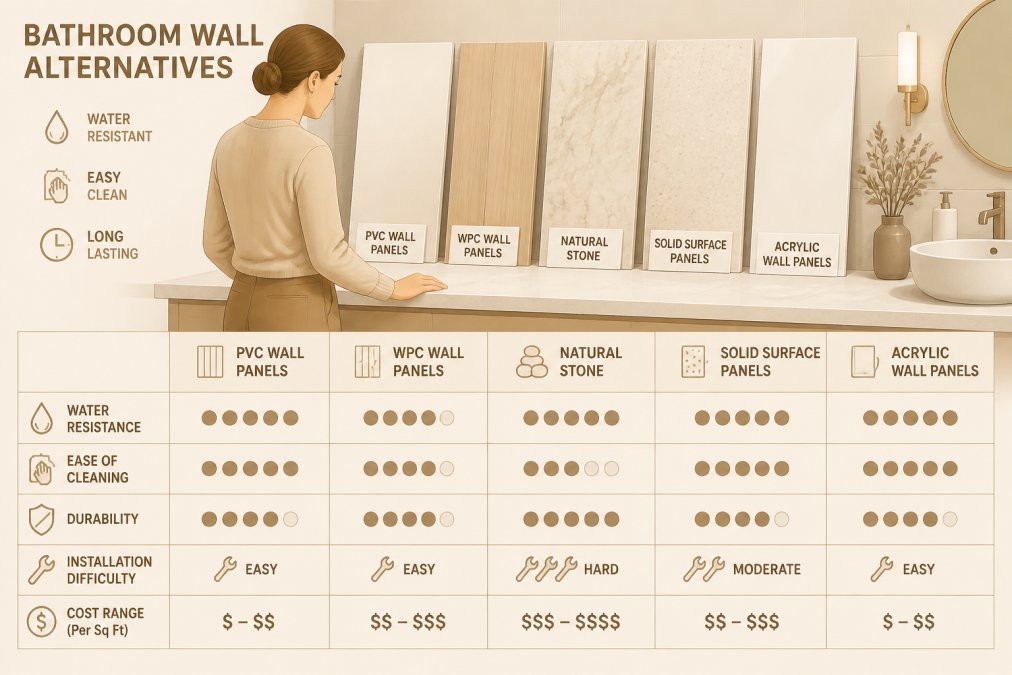
Bathroom wall panels have become the go-to alternative for wet zones. They're waterproof by design, install quickly, and require almost no maintenance. Panels come in several materials, each with distinct trade-offs.
PVC and Composite Panels
PVC panels are rigid plastic sheets that click or screw together to form seamless wall systems. Composite panels blend PVC with other materials for added durability. Both eliminate grout lines entirely.
Advantages:
- Completely waterproof; no moisture can penetrate seams
- Install in a fraction of the time ceramic tile requires
- No grout to clean or reseal
- Affordable upfront cost
- Wide range of finishes (marble-look, wood-look, solid colors)
Limitations:
- Can feel plastic-like to the touch
- Some lower-quality panels yellow or warp over time
- Limited customization for unique layouts
- Difficult to repair if damaged; may require panel replacement
- Not ideal for high-end design aesthetics
Installation and Maintenance
PVC and composite panels mount directly to wall studs or over existing tile. Installation typically takes one to three days for a full bathroom, compared to a week or more for ceramic tile.
The trade-off is longevity. Quality PVC panels last 10-15 years in wet zones before degradation becomes visible. Ceramic tile, by contrast, lasts 20+ years if grout is maintained properly.
Waterproof Bathroom Wall Panels for Wet Zones
Not all wall panels are waterproof. Decorative panels sold for dry areas can swell, delaminate, or grow mold behind the surface when installed in a shower. For shower interiors and the splash zone around a tub, you need panels engineered for continuous moisture exposure, with sealed seams and a moisture-resistant substrate.
Wet-Zone Boundaries: Where Waterproofing Is Actually Required
Building codes and good practice distinguish three zones:
- Wet zone (shower interior, tub surround): Direct, daily water contact. Requires waterproof panels or a waterproof membrane behind the finish. Seams must be sealed.
- Splash zone (typically 600 mm above and around fixtures): Frequent splashing but no standing water. Water-resistant panels or well-sealed paint are usually sufficient.
- Dry zone (upper walls, powder rooms, areas away from fixtures): No direct water. Decorative finishes are fine.
A common mistake is treating the entire bathroom as a wet zone and over-spending, or treating the shower as a dry zone and creating a mold problem. Match the material to the zone.
Panel Types Engineered for Wet Zones
Acrylic-faced panels use a rigid acrylic sheet bonded to a moisture-resistant backing.
Fiberglass-reinforced plastic (FRP) panels are common in utility and rental bathrooms.
Stone-composite or mineral-core panels combine stone dust or mineral filler with resin binders.
PVC and composite panels are the budget option. They are genuinely waterproof, but lower grades can flex, discolor, or warp in hot, steamy showers.
Seams, Substrate, and Installation Requirements
Waterproofing fails at the seams, not the panel face. Panels must be installed with:
- A level, sound substrate. Panels can often go over existing tile if the tile is well-bonded and flat, but loose tile, bowed studs, or water-damaged drywall must be repaired first.
- Sealed seams. Use manufacturer-specified sealant or proprietary joint profiles. Silicone alone can fail if the panels move.
- Correct trim and corner profiles. Inside and outside corners need matching profiles, not caulk-only joints.
- A moisture-resistant backing. In a shower, a waterproof membrane or cement backer board behind the panels is best practice, even when panels claim to be waterproof.
Cost and Lifespan in Wet Zones
Upfront cost varies widely by material. PVC and FRP are the lowest-cost options. Acrylic-faced and stone-composite panels sit in the middle. Solid-surface and high-end stone-look panels cost the most.
Lifespan in a wet zone depends on material and installation quality. Budget PVC may last 10-15 years. Acrylic and stone-composite panels commonly last 15-20 years.
Acrylic Shower Wall Panels: Seamless and Durable
Acrylic surrounds (three-wall shower enclosures) are one-piece or multi-piece systems that create a completely seamless wet zone. They're popular in renovations because they simplify the wet-zone challenge.
Advantages Over Traditional Tile
Acrylic is non-porous, so it resists mold and mildew naturally. Seams are minimal and sealed, eliminating grout failure.
Acrylic panels are also impact-resistant. A dropped bottle won't crack them the way it cracks ceramic tile. This matters in households with children or active use.
Design options have expanded. Modern acrylic surrounds mimic natural stone, marble, and subway tile patterns. They don't look cheap anymore.
Cost and Lifespan Comparison
Acrylic surrounds cost more upfront than PVC panels but less than high-end natural stone. A mid-range acrylic surround runs moderately priced for a three-wall enclosure, installed.
Lifespan favors acrylic. Quality acrylic lasts 15-20 years in residential use. The material doesn't degrade as quickly as budget PVC.
Microcement Bathroom Walls: Industrial Elegance
Microcement is a thin, cement-based coating applied over existing walls. It creates a seamless, monolithic finish, no grout lines, no seams.
Microcement works in both wet and dry zones. In wet areas, it's sealed with a waterproof topcoat.
Advantages:
- Seamless, modern appearance
- Thin application (2-3 mm) works over existing surfaces
- Highly customizable colors and textures
- Waterproof when properly sealed
- Long lifespan (15-20 years with proper maintenance)
Limitations:
- Requires skilled application; not a DIY material
- Higher upfront cost than panels
- Needs periodic resealing (every 2-3 years in wet zones)
- Can crack if substrate shifts or settles
- Repair is visible; patching doesn't blend seamlessly
Microcement suits homeowners who prioritize design and don't mind maintenance. It's not the lowest-cost option, but it delivers a premium look that ceramic tile can't match.
Natural Stone and Stone-Resin Surfaces
Natural stone (marble, granite, slate) brings luxury and permanence to bathroom walls. Stone-resin composites offer similar aesthetics with better durability and easier installation.
Natural stone is porous and requires sealing. In wet zones, it must be sealed annually to prevent water penetration and staining.
Stone-resin composites (engineered quartz or porcelain-look panels) combine stone dust with resin or porcelain.
Both options work well in dry areas and as accent walls.
Paint, Wallpaper, and Finishes for Dry Areas
Not every bathroom wall needs to be waterproof. Walls above the splash zone, powder room walls, and walls away from direct water exposure can use decorative finishes that cost less and offer more design freedom than tile or panels. The key is knowing where the moisture boundary sits and choosing a finish rated for that exposure.
Where Dry-Area Finishes Are Appropriate
A practical rule: if the wall is inside a shower or tub surround, or within roughly 600 mm of a fixture that splashes, treat it as a wet or splash zone. Everything above and away from that can usually take a decorative finish. Powder rooms, which have no shower or tub, are almost entirely dry-zone spaces.
Bathroom-Rated Paint
Standard interior paint is not formulated for the humidity swings a bathroom sees. Bathroom-rated paint uses a mildew-resistant additive and a harder, more washable finish. Sheen matters more than brand:
- Satin or semi-gloss: Best balance of moisture resistance and cleanability. Semi-gloss is the most washable but shows wall imperfections.
- Eggshell: Acceptable in low-moisture powder rooms, but less resistant to repeated wiping.
- Flat or matte: Not recommended in bathrooms except in very dry, well-ventilated powder rooms.
Proper surface prep matters as much as the paint. A primer designed for high-humidity areas improves adhesion and reduces the risk of peeling. Expect to repaint every 5-7 years in a frequently used bathroom, sooner if ventilation is poor.
Bathroom Wallpaper
Wallpaper has returned to bathroom design, but not all wallpaper belongs there. Vinyl-coated and vinyl-embossed wallpapers resist moisture and are wipeable. Non-woven and paper-backed wallpapers can lift, bubble, or grow mold in humid conditions.
For a bathroom, look for:
- Vinyl or vinyl-coated wallpaper for splash-adjacent walls.
- Moisture-resistant adhesive specified for humid environments.
- Smooth, sealed surfaces that can be wiped without damaging the pattern.
Avoid wallpaper directly inside a shower or in the immediate splash zone. Even moisture-resistant wallpaper is not a waterproofing layer.
Decorative Alternatives to Paint and Wallpaper
Other dry-area finishes worth considering:
- Limewash and mineral paints: Breathable, matte finishes with a soft, textured look. They handle humidity better than standard latex but are not washable like semi-gloss.
- Wall panels in decorative finishes: Wood-look, concrete-look, and fabric-look panels can be used on dry walls to add texture without the maintenance of real wood or fabric.
- Peel-and-stick tiles and murals: Useful for renters or accent walls, but they are decorative, not waterproof, and should stay out of wet zones.
Ventilation Is the Real Variable
No dry-area finish performs well in a bathroom with poor ventilation. A properly sized exhaust fan, run during and after showers, does more to protect paint and wallpaper than any product upgrade. In older homes without a fan, adding one is often the highest-value renovation for finish longevity.
Trade-Offs to Accept
Paint and wallpaper are the least expensive wall finishes and the easiest to change. They are also the least durable in high-moisture conditions. If a wall sees regular steam and splashing, a panel or solid-surface finish will outlast paint by years. Choose dry-area finishes where they belong, and use waterproof materials where they do not.
Solid-Surface and Glass Wall Options
Solid-surface materials (like Corian) are engineered polymers that mimic stone. They're non-porous, seamless, and repairable. Damage can be sanded out, unlike tile or acrylic.
Solid-surface works well in shower walls and wet zones. Cost is moderate to high.
Glass wall panels are becoming more common in modern bathrooms. Tempered glass is durable and waterproof. It creates an open, spacious feel.
Both options suit design-forward homeowners willing to invest in quality finishes.
Choosing the right alternative to ceramic tile depends on your bathroom's function, your budget, and your maintenance tolerance. When you're ready to move forward, Restmark Renovations can help you evaluate options and manage the installation with transparent pricing and clear timelines. Get a Free Estimate today and let's transform your bathroom into a space that works for how you actually live.
Frequently Asked Questions
What is the best waterproof material for bathroom walls?
The best choice depends on your budget and wet-zone needs. Waterproof bathroom wall panels offer seamless, grout-free protection ideal for shower surrounds. Acrylic and fiberglass panels are durable and easy to maintain. Stone-resin composites provide luxury finishes with excellent water resistance. For dry zones, paint and wallpaper work well. Each material has different upfront costs and lifespans, so consider both immediate investment and long-term durability when deciding.
Are bathroom wall panels better than tiles?
Bathroom wall panels offer distinct advantages: no grout lines to clean, faster installation, and seamless waterproofing. They're easier to maintain and generally more budget-friendly upfront. However, ceramic tile offers more design variety and can last decades with proper care. Panels excel in wet zones like shower surrounds, while tile works well in dry or lightly splashed areas. The best choice depends on your bathroom layout, maintenance preferences, and design vision.
Can you use waterproof paint instead of tile in a bathroom?
Waterproof paint works for dry bathroom areas and accent walls, but it's not suitable for direct shower spray zones. Paint requires proper surface preparation and regular reapplication to maintain water resistance. For wet zones, waterproof panels, acrylic surrounds, or stone-resin surfaces are more reliable. Paint is cost-effective for updating dry walls and pairs well with other materials in a mixed-finish bathroom design.
How much do bathroom wall panels cost compared with tile?
Panel costs vary by material and quality. Basic PVC panels are often more affordable upfront than ceramic tile, while premium acrylic or stone-resin panels may cost similarly or more. Installation typically costs less for panels since they require fewer steps than tiling. For accurate pricing tailored to your project scope, consult with a renovation professional who can assess your specific bathroom layout and material preferences.