 how-to
Best Kitchen Lighting for Small Spaces: A 2026 Guide
Table of Contents
- Why Kitchen Lighting Matters in Compact Spaces
- Recessed Lighting in Small Kitchens: Maximizing Overhead Space
- Under-Cabinet Lighting for Kitchens: Brightening Work Surfaces
- Lighting for Low-Ceiling Kitchens: Smart Fixture Selection
- Best Color Temperature for Kitchen Lighting: Warm vs. Cool
- Layering Ambient, Task, and Accent Lighting
- Practical Lighting Plan: Placement, Spacing, and Installation
- Frequently Asked Questions
Last Updated: October 6, 2026
Why Kitchen Lighting Matters in Compact Spaces
Kitchen lighting in small spaces requires strategic planning because poor illumination creates shadows, makes food preparation dangerous, and makes a compact room feel even smaller. The best kitchen lighting for small spaces combines multiple fixture types layered thoughtfully to serve both function and aesthetics.
At Restmark Renovations, we guide homeowners through kitchen renovations where lighting transforms how the space feels and performs. A poorly lit compact kitchen becomes frustrating to cook in. The right fixtures, recessed lights, under-cabinet LEDs, and pendant lights positioned correctly, turn a cramped kitchen into an efficient, welcoming space.
The challenge in small kitchens isn't just brightness. It's placement. You have limited ceiling height, limited counter space, and limited room for fixtures that might work beautifully in a larger kitchen. Every fixture needs to earn its place by serving a specific purpose: general illumination, task lighting for work surfaces, or accent lighting to define the space visually.
Recessed Lighting in Small Kitchens: Maximizing Overhead Space
Recessed lighting is the workhorse of small-kitchen illumination because it sits flush with the ceiling, taking up zero visual space. This matters more in compact kitchens where every inch of perceived openness counts.
Recessed lights work best for general ambient lighting, the baseline brightness that lets you move safely through the kitchen. They're subtle enough not to overwhelm a small space visually, yet powerful enough to brighten the entire room when spaced correctly. The rule of thumb is to space them 1.2 to 1.5 metres apart, depending on how deep they sit into the ceiling and the brightness you need.
In a small kitchen, 3 to 5 recessed lights are usually sufficient. Too many creates visual clutter on the ceiling; too few leaves dark corners. Position them to avoid casting shadows over your main work zones, the sink and stove. Offset them slightly if possible so light hits these areas directly.
One practical consideration: recessed lights need clearance above the ceiling for the housing. If your kitchen has limited attic space or runs into joists, you may need shallow-housing models, which cost slightly more but fit tight spaces. This is worth the investment because it keeps your ceiling line clean.
Under-Cabinet Lighting for Kitchens: Brightening Work Surfaces
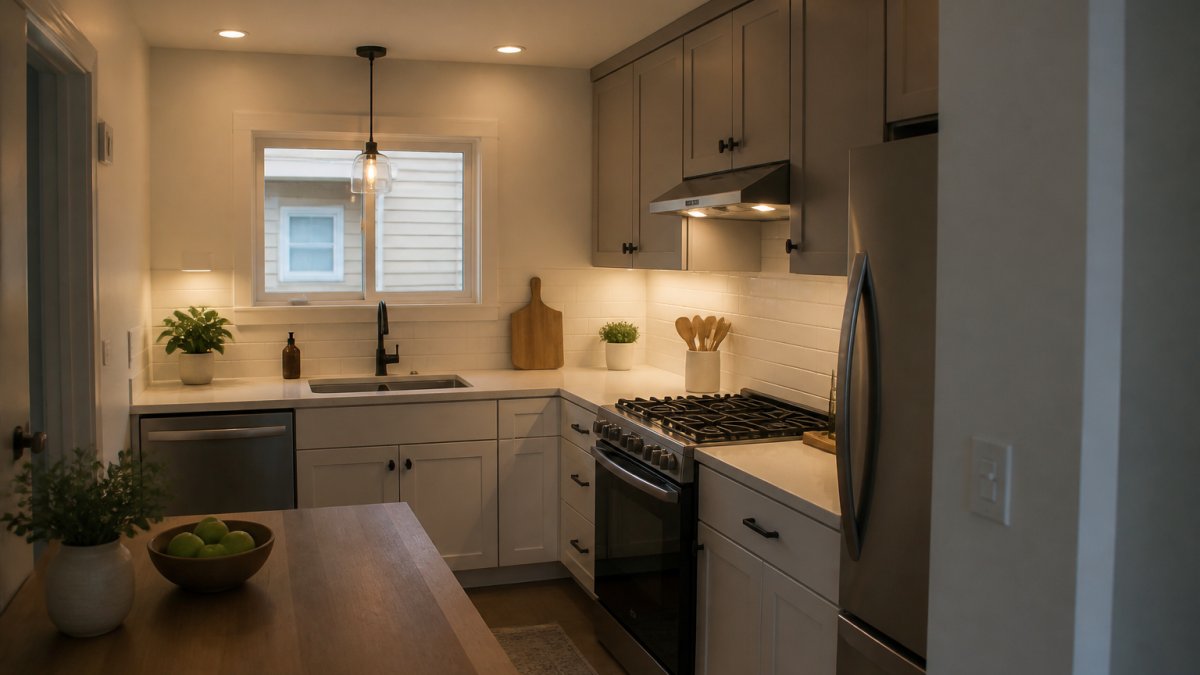
Under-cabinet lighting for kitchens solves the shadow problem that recessed lights create. LED strips mounted on the underside of cabinets shine directly onto your countertops, eliminating the dark zones where you prepare food.
This is task lighting; it targets the exact surfaces where you need to see clearly. LED strips are ideal because they're thin, cool-running, and energy-efficient. They mount with adhesive or small clips and wire back to a power source. Modern LED strips come in different color temperatures, which we'll cover in the next section.
For small kitchens, under-cabinet lighting does double duty: it brightens work surfaces and visually expands the space by drawing light downward and outward. This creates a sense of openness that recessed lights alone can't achieve.
Install LED strips the full length of upper cabinets where you have counter space below. If you have open shelving, skip it there; the light will scatter and create glare. Focus on closed cabinets over actual work zones: prep areas, the sink, and anywhere you chop, mix, or assemble meals.
A common mistake is installing strips too close to the edge of the cabinet, which creates a bright line that's visually distracting. Mount them 2 to 3 inches back from the front edge so light spreads evenly across the counter below.
Lighting for Low-Ceiling Kitchens: Smart Fixture Selection
Low ceilings eliminate several lighting options outright. Chandeliers, large pendant lights, and deep recessed fixtures that hang down become hazards or visual problems. Your approach shifts to fixtures that work within tight vertical constraints.
Flush-mount and semi-flush-mount ceiling lights sit close to the ceiling, leaving 6 to 8 inches of clearance. In a kitchen with 8-foot ceilings, common in older homes, this is often your only overhead option besides recessed lights. Semi-flush mounts hang slightly lower than flush mounts but still clear the head of a tall person walking beneath them.
For low ceilings, prioritize fixtures with upward-facing bulbs or diffusers that bounce light upward and outward. This creates the illusion of higher ceilings by directing attention upward. Downward-facing fixtures in tight spaces make the room feel more cramped.
Under-cabinet lighting becomes even more critical in low-ceiling kitchens because overhead fixtures alone struggle to fill the space with enough light. The combination of recessed or flush-mount overhead lights plus under-cabinet LEDs gives you full coverage without making the ceiling feel oppressive.
Pendant lights over an island are possible in low-ceiling kitchens, but choose mini pendants, 3 to 4 inches in diameter, rather than full-sized ones. Hang them 24 to 30 inches above the counter to avoid hitting heads while keeping visual proportion balanced.
Best Color Temperature for Kitchen Lighting: Warm vs. Cool
Color temperature, measured in Kelvin (K), changes how food looks, how alert you feel, and how spacious the kitchen appears. This choice matters more than most homeowners realize.
Warm light (2700K to 3000K) has a yellowish tone. It flatters skin, makes food look appetizing, and creates a cozy atmosphere. Cool light (4000K to 5000K) has a bluish tone. It feels clinical but makes details sharper and helps you see true colors, important for food preparation and recipe work.
For small kitchens, warm light (3000K) is the better choice because it makes the space feel more inviting and less sterile. Bright cool light in a compact room can feel harsh and cold. The trade-off is that cool light technically offers better visibility for detail work, but the psychological benefit of warmth outweighs this in a space where you spend time daily.
Use warm light for ambient and accent lighting. For task lighting under cabinets, you can go slightly cooler (3500K to 4000K) to improve visibility on cutting boards and prep surfaces. This layered approach, warm overhead, slightly cooler task lighting, balances function and comfort.
LED bulbs and strips let you choose color temperature at purchase, so there's no guesswork. Buy all your lights at the same Kelvin rating unless you're specifically layering warm and cool intentionally.
Layering Ambient, Task, and Accent Lighting
Layered lighting is the framework that makes small kitchens work. It means combining three types of light, each with a specific job.
Ambient lighting is your baseline, the general brightness that lets you move safely and see the overall space. Recessed lights or flush-mount fixtures provide this. Aim for enough light that you don't need to squint, but not so much that the space feels institutional.
Task lighting targets work surfaces where precision matters: the sink, stove, and prep areas. Under-cabinet LEDs are the primary task lighting in kitchens. Some people add a small pendant light over the island or a track light above the stove for extra visibility.
Accent lighting is optional but transforms a small kitchen visually. It might be a light inside open shelving, a strip light under a floating shelf, or a small spotlight on a backsplash.
In a small kitchen, you might use 3 to 5 recessed lights for ambient, under-cabinet LEDs for task, and one accent element like a lit shelf. This combination covers function while keeping the visual footprint minimal.
The key is that each layer should be independently dimmable or switchable. You want bright task lighting while cooking, softer ambient light while eating, and accent lighting during the evening. Smart bulbs or separate switches make this possible without adding visual clutter.
Practical Lighting Plan: Placement, Spacing, and Installation
A practical plan starts with your kitchen's dimensions and existing features. Measure ceiling height, counter depth, cabinet height, and the distance from upper cabinets to the counter below.
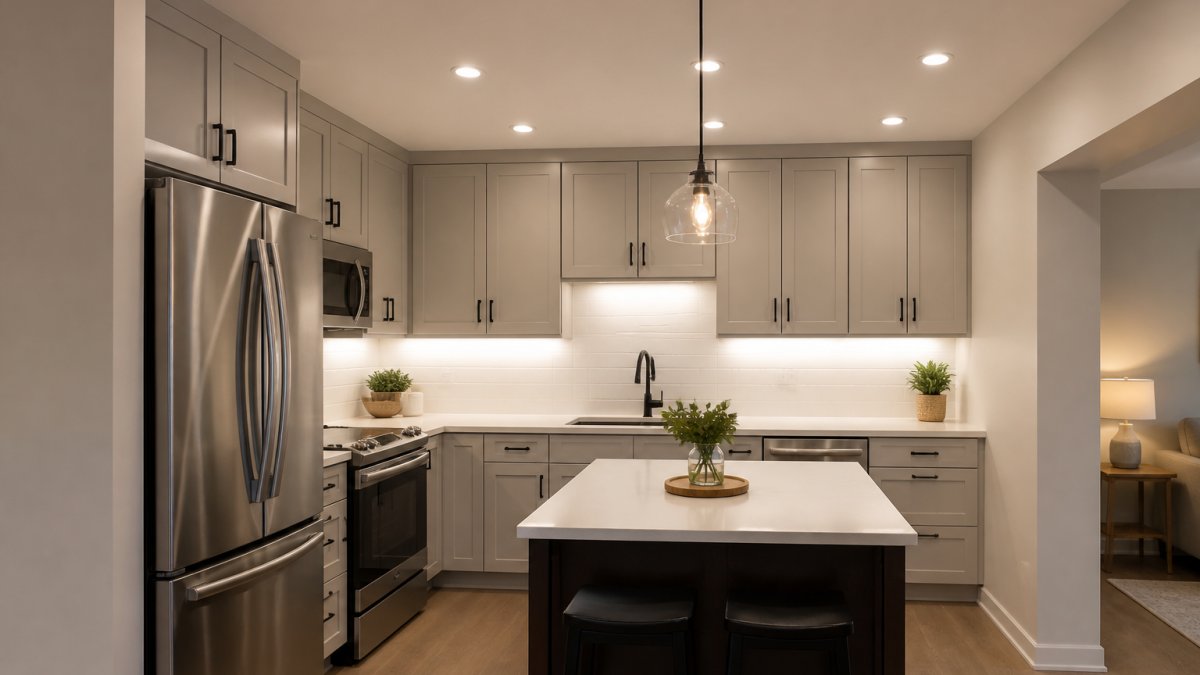
For a typical small kitchen (7.4 to 11.1 square metres):
- Place 3 to 4 recessed lights in the main work zone, spaced 1.2 to 1.5 metres apart
- Install under-cabinet LEDs along the full length of cabinets above the sink and prep area
- Add one pendant light (mini size) over an island if space allows, hung 0.6 to 0.75 metres above the counter
- Consider one accent light, perhaps inside a glass cabinet or along a backsplash, for visual interest
Spacing matters because light spreads in a cone. A recessed light 8 feet up spreads wider than one in a 7-foot ceiling.
Installation depends on whether you're renovating or updating existing fixtures. Recessed lights in new construction are straightforward; the electrician runs wiring and installs housings before drywall.
Under-cabinet LEDs are easier. Most modern strips use adhesive backing and plug into a power outlet or hardwired connection.
Pendant lights over an island need a ceiling outlet directly above. If one doesn't exist, running new wiring means opening walls or running surface-mounted conduit, which adds cost.
For small kitchens, consider whether your current electrical panel has capacity for additional circuits. Kitchens require dedicated circuits for safety, and adding multiple light zones might require new wiring.
The best kitchen lighting for small spaces isn't about buying the brightest fixtures.
If you're planning a kitchen renovation and lighting feels overwhelming, that's normal. At Restmark Renovations, we help homeowners navigate these decisions as part of our kitchen renovation process, ensuring your new space is both beautiful and functional. Get a free estimate to discuss your lighting plan with our team, and we'll show you exactly how to brighten your compact kitchen while preserving the character and flow of your home.
| Fixture Type | Best For | Placement | Brightness |
|---|---|---|---|
| Recessed lights | Ambient/general illumination | Ceiling, spaced 1.2-1.5 metres apart | Moderate to bright |
| Under-cabinet LEDs | Task lighting on work surfaces | Underside of upper cabinets | Focused, moderate |
| Mini pendants | Island accent and task light | 0.6-0.75 metres above counter | Moderate, directional |
| Flush-mount lights | Low-ceiling ambient lighting | Directly on ceiling | Moderate |
| Track lighting | Flexible task and accent | Mounted on ceiling or wall | Variable |
According to the Canadian Electrical Code, kitchen lighting circuits must meet specific safety standards, and any new wiring should be installed by a licensed electrician.
Research from the National Kitchen & Bath Association emphasizes that layered lighting, combining ambient, task, and accent light, is the gold standard for functional kitchen design, especially in compact spaces where every fixture must serve multiple purposes.
The Illuminating Engineering Society's lighting guidelines recommend 50 foot-candles of light on kitchen work surfaces for safe food preparation.
Frequently Asked Questions
What is the best color temperature for kitchen lighting in a small space?
Neutral white (4000K to 4100K) works best for small kitchens because it provides clarity for food preparation without making the space feel cold or too warm. This color temperature reduces shadows and improves visibility on countertops and work surfaces. If you prefer a cozier ambiance, warm white (2700K to 3000K) is acceptable for ambient lighting, but pair it with neutral task lighting over islands and prep areas.
Are recessed lights or flush-mount lights better for small kitchens?
Recessed lighting is ideal for small kitchens because it sits flush with the ceiling, preserving headroom and creating a clean, uncluttered look. Flush-mount and semi-flush-mount lights work well as secondary fixtures or accent lighting, but recessed lights should form the foundation of your general illumination. In kitchens with very low ceilings (under 2.4 metres), recessed lights are nearly essential to avoid the space feeling cramped.
How do I avoid glare and shadows in a small kitchen with limited ceiling space?
Combine multiple light sources at different levels: recessed lights overhead for general illumination, under-cabinet lighting to eliminate shadows on work surfaces, and pendant lights or track lighting to add task light where needed. Space recessed lights 1.2 to 1.5 metres apart for even coverage. Use matte or diffused fixtures to reduce harsh glare, and consider dimmable LED bulbs so you can adjust brightness for different times of day and tasks.
Can I install kitchen lighting myself, or do I need a professional?
Under-cabinet LED strips and some plug-in fixtures are renter-friendly and DIY-accessible. However, recessed lights, pendant fixtures, and any hardwired installations require a licensed electrician to ensure code compliance and safety. Improper wiring can create fire hazards or electrical failures. A professional installation also guarantees that your lighting plan meets local electrical codes and integrates properly with your kitchen's existing circuits.