 ultimate-guide
Is $10,000 Enough for a New Kitchen?
Table of Contents
- Is $10,000 Enough for a Kitchen Renovation?
- Variables Influencing Kitchen Renovation Costs
- Average Cost of Kitchen Renovation by Scope
- Budget Kitchen Remodel Ideas That Deliver Impact
- Kitchen Renovation Timeline and Phased Approach
- DIY vs. Professional Labor: Where to Invest
- Hidden Costs and Contingency Planning
- ROI and Resale Value Considerations
- Frequently Asked Questions
Last Updated: September 25, 2026
Is $10,000 Enough for a Kitchen Renovation?
Is $10,000 enough for a new kitchen? Yes, if you're strategic about where you invest. A $10,000 kitchen renovation can deliver a modern, functional space with thoughtful material choices and smart prioritization, but you'll need to make deliberate trade-offs and focus on high-visibility upgrades that transform how the space looks and functions.
The scope depends on your priorities: some prioritize appliances and fixtures, others focus on cabinetry and countertops. Understanding these variables upfront prevents budget creep and keeps your project on track.
Variables Influencing Kitchen Renovation Costs
Kitchen size and layout matter significantly. A small galley kitchen costs less to renovate than a large open-concept space. Labour costs scale with the work involved: more cabinetry means more installation time, more plumbing changes mean higher subcontractor fees.
Material quality and finishes are the biggest cost variables. Laminate countertops cost substantially less than quartz or granite. Stock cabinetry costs far less than semi-custom options. Your material choices determine whether you're at the low or high end of your budget.
Labour versus DIY work significantly affects costs. Professional installation ensures quality and warranty protection but adds expense. Handling demolition, painting, or simple tile work yourself reduces labour costs. However, electrical, plumbing, or structural work requires licensed professionals.
Supply chain timing and availability affects pricing. Planning ahead gives you flexibility; rushing forces higher prices or longer wait times.
Average Cost of Kitchen Renovation by Scope
Cosmetic refresh focuses on painting cabinets, replacing hardware, updating backsplash, and refreshing fixtures. This approach typically costs $3,000-$6,000 and works well when cabinets are structurally sound but dated. Results are visible and impactful, especially when paired with new lighting or wall paint.
Mid-range renovation includes cabinet refacing, new countertops, updated appliances, and improved lighting. This scope runs $6,000-$12,000 and transforms functionality and aesthetics while keeping the existing layout. Most homeowners find this offers the best value.
Full kitchen overhaul involves new cabinetry, plumbing changes, electrical upgrades, flooring replacement, and complete appliance updates. This scope typically exceeds $15,000-$20,000. With a $10,000 budget, a full overhaul isn't realistic.
For most homeowners asking is $10,000 enough for a new kitchen, a mid-range renovation or high-end cosmetic refresh delivers the best return on investment and aligns with realistic material and labour costs.
Budget Kitchen Remodel Ideas That Deliver Impact
Strategic upgrades create the illusion of a complete kitchen renovation without the full price tag. The key is choosing changes that affect how the space looks and functions daily.
Paint and hardware updates are the most cost-effective starting point. Fresh cabinet paint in a modern colour transforms the kitchen for under $1,000. New hardware, lighting fixtures, and wall colour add another $500-$800 with minimal labour required.
Backsplash installation modernizes the wall space above counters. Subway tile or simple ceramic options cost $800-$1,500 installed and become a focal point that makes the kitchen feel updated.
Countertop replacement is often the highest-impact upgrade within a $10,000 budget. Laminate or solid-surface countertops run $1,500-$2,500 installed; quartz or engineered stone costs $2,500-$4,000. New countertops anchor appearance and improve functionality but may require scaling back appliances or cabinetry.
Cabinet Refacing vs. Replacement
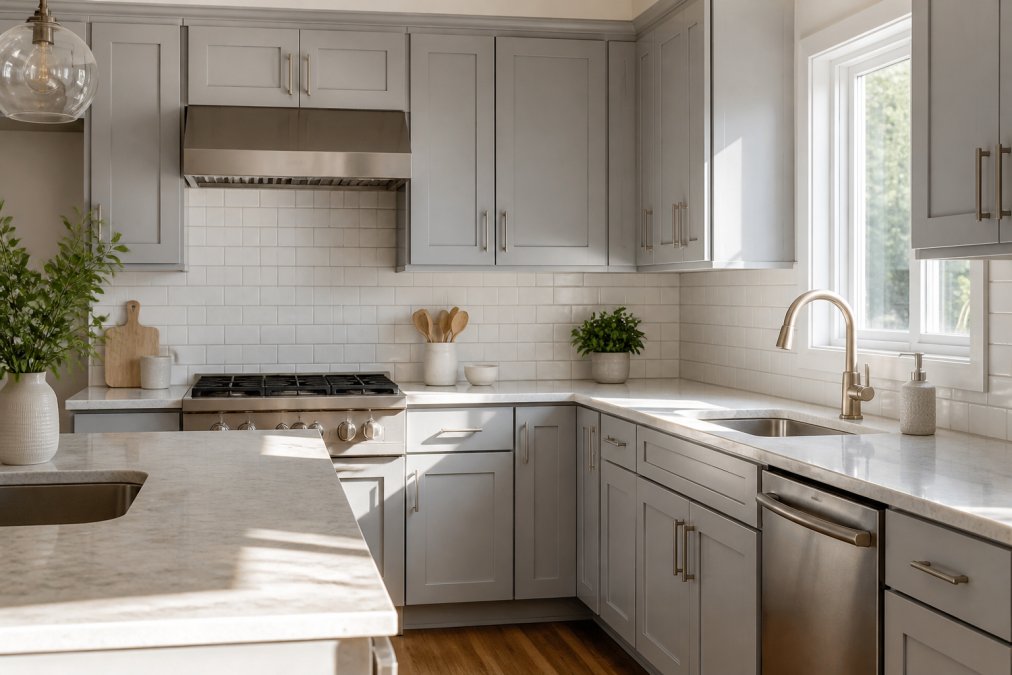
Cabinet refacing preserves existing structure while replacing doors, drawer fronts, and hardware. Refacing typically costs $3,000-$5,000 and takes 1-2 weeks. This approach works well if cabinets are well-built but visually outdated, delivering a transformed look without full replacement expense.
Full cabinet replacement removes and installs entirely new cabinetry. Stock cabinets cost $4,000-$7,000 installed; semi-custom options run $7,000-$12,000. Full replacement takes 3-4 weeks and disrupts your kitchen significantly. For a $10,000 budget, full replacement usually isn't feasible unless you choose budget-friendly stock options.
For most homeowners, cabinet refacing offers better value within a $10,000 budget. You achieve a modern look without the labour intensity and cost of replacement.
| Option | Cost Range | Timeline | Best For |
|---|---|---|---|
| Cabinet Refacing | $3,000-$5,000 | 1-2 weeks | Well-built cabinets needing visual update |
| Stock Cabinet Replacement | $4,000-$7,000 | 3-4 weeks | Budget-conscious full overhaul |
| Semi-Custom Replacement | $7,000-$12,000 | 4-6 weeks | Custom sizing and premium finishes |
Countertop and Backsplash Strategy
Countertops and backsplash work together to define the kitchen's aesthetic. Choosing materials strategically keeps costs aligned with your $10,000 budget.
Laminate and solid-surface countertops deliver clean, modern looks at $1,500-$2,500 installed. Pair them with a striking backsplash to elevate appearance; a bold backsplash compensates for modest countertop materials.
Quartz and engineered stone cost $2,500-$4,000 installed, consuming more budget but reducing need for expensive backsplash upgrades. These materials look high-end and hold up well to daily use.
Backsplash tile choices range from budget subway tile at $800-$1,200 installed to premium options at $1,500-$2,000. The backsplash is a visual anchor, a striking design here justifies modest countertop materials. Conversely, premium countertops can stand alone with simple tile behind them.
The strategy: invest heavily in either countertops or backsplash, not equally in both. This approach maximizes visual impact while respecting your budget.
Appliances and Fixtures on Budget
Appliances and fixtures significantly affect kitchen functionality and appearance, but they can quickly consume your entire budget if you're not strategic.
Budget appliance packages from major retailers offer 3-piece sets (refrigerator, range, dishwasher) at $2,000-$3,500. These are reliable, basic models adequate for most households. Package deals save money compared to purchasing individually.
Mid-range appliances cost $4,000-$6,000 for a 3-piece set and offer better aesthetics, more features, and improved performance. Stainless steel finishes look more contemporary.
Fixtures and hardware include faucets, lighting, and cabinet handles. A quality kitchen faucet runs $300-$600; lighting upgrades cost $400-$800; cabinet hardware ranges from $200-$500. Together, these details cost $1,000-$2,000 and significantly improve the kitchen's feel and functionality.
For a $10,000 budget, prioritize reliable mid-range appliances and invest in fixtures that improve daily use. Premium appliances consume too much of your budget; budget models work fine if you upgrade other areas.
Kitchen Renovation Timeline and Phased Approach
A $10,000 kitchen renovation typically takes 4-8 weeks from start to finish, depending on complexity and whether you phase the work. Understanding the timeline helps you plan for kitchen disruption and coordinate with contractors.
Week 1-2: Planning and design. Finalize material choices, get quotes, and book contractors. Order materials and confirm delivery dates.
Week 3-4: Demolition and preparation. Existing cabinetry, countertops, and backsplash are removed. Electrical and plumbing work happens if needed. Your kitchen is largely unusable; plan for takeout meals and limited cooking access.
Week 5-7: Installation. New cabinetry, countertops, backsplash, appliances, and fixtures are installed. This phase is the longest and most disruptive. Coordination between multiple trades is critical.
Week 8: Final touches. Hardware is installed, final paint touch-ups happen, and everything is cleaned. You do a final walkthrough with your contractor to confirm everything meets expectations.
Phased approach: Consider phasing your renovation to spread costs and disruption. Year one: cabinet refacing and backsplash ($4,000-$5,000). Year two: countertop replacement and new appliances ($5,000-$6,000). This minimizes household disruption but extends the timeline and may increase total costs due to separate labour charges.
A phased approach works well when budget is tight or you want to test material choices before committing fully. The downside is that your kitchen remains partially updated during the interim period.
DIY vs. Professional Labor: Where to Invest
Deciding what to handle yourself versus what to outsource directly affects your budget and project timeline. Some tasks are DIY-friendly; others require licensed professionals and shouldn't be compromised.
DIY-friendly tasks include painting cabinets, installing hardware, demolition and prep work, and simple tile backsplash installation. These tasks save $1,000-$2,000 in labour costs but take longer and mistakes can be costly to fix.
Professional-only work includes electrical upgrades, plumbing changes, gas line work, and built-in appliance installation. These tasks require licensed trades and building permits. Cutting corners here creates safety hazards and code violations. Budget for professional installation, this is non-negotiable.
Middle-ground tasks like countertop and cabinet installation require skill but aren't necessarily professional-only.
Hidden Costs and Contingency Planning
Structural issues are the most common hidden cost. Once walls are opened, contractors may discover rotting wood, outdated wiring, or plumbing problems. Budget 10-15% contingency ($1,000-$1,500) for these discoveries.
ROI and Resale Value Considerations
Kitchen renovations are among the highest-returning home improvements. Understanding the financial impact helps justify your investment.
Frequently Asked Questions
What is a realistic budget for a new kitchen?
A realistic kitchen renovation budget depends on scope. A minor refresh with cabinet refacing, new hardware, and paint runs significantly less than a full kitchen remodel involving layout changes and new plumbing. For a $10,000 budget, focus on high-impact, visible elements like cabinetry updates, countertops, and fixtures rather than structural work. Professional guidance helps prioritize spending to maximize your investment.
What hidden costs should I expect in a kitchen remodel?
Common hidden costs include structural issues discovered during demolition, electrical or plumbing upgrades required by code, unexpected water damage in older homes, disposal and site cleanup, and permit fees. Setting aside 10-15% of your budget as a contingency fund protects against surprises. Professional contractors experienced with older homes can often anticipate these issues during the initial assessment.
How long does a typical kitchen renovation timeline take?
A full kitchen renovation typically takes 6-12 weeks depending on scope and complexity. Simpler updates like cabinet refacing and countertop replacement may finish in 4-6 weeks. Phased approaches, completing high-priority items first and spreading work over time, can extend the timeline but manage budget pressure and minimize disruption. Your contractor should provide a realistic schedule during the planning phase.
Can you achieve a high-end look with a $10,000 budget?
Yes, strategic choices create a high-end appearance within $10,000. Focus spending on visible elements: quality cabinet refacing or semi-custom cabinetry, durable countertop materials, and modern fixtures. Choose neutral colors and finishes that feel timeless. Mid-range appliance packages offer good value. Avoid spreading budget too thin across too many upgrades; depth in fewer areas outperforms shallow changes everywhere.